Polyester Taffeta vs Pongee vs Oxford – Which Rainwear Base Fabric to Choose?
In our previous article, we compared PVC, PU, and TPU coatings, as well as polyester and nylon base fabrics. After publishing, a reader asked a very practical question: “Among polyester base fabrics, what’s the difference between taffeta, pongee, and oxford? Which one should I choose for rainwear?”
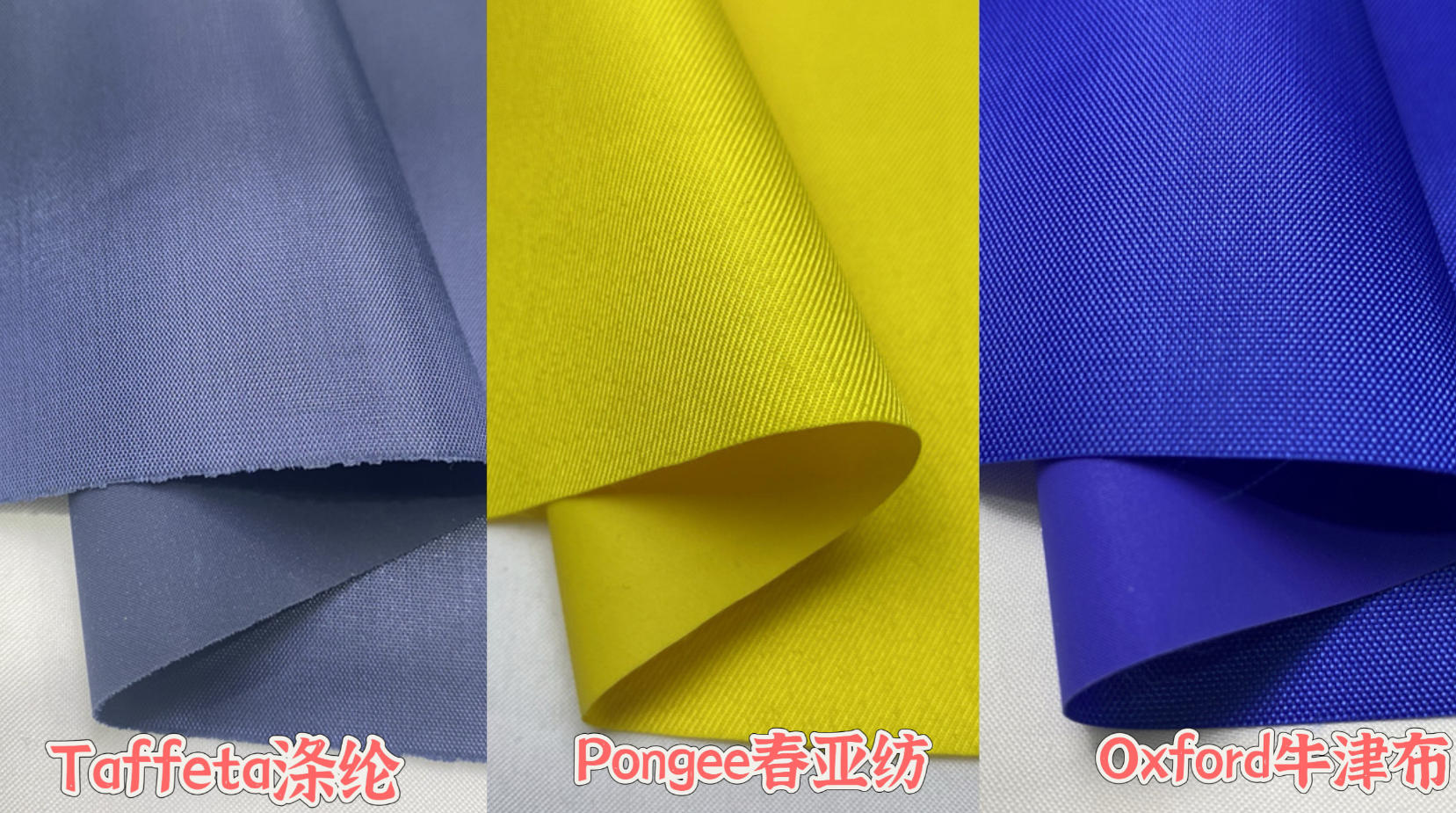
This is an excellent question. Polyester taffeta, pongee, and oxford – they are all made of polyester fibers, but their weaving methods, yarn specifications, and hand feel are completely different-8-. In other words, they are different “noodles” made from the same “flour” – same raw material, but very different texture and performance.
This article provides a detailed breakdown of these three polyester base fabrics to help B2B buyers make precise choices based on product positioning and cost.
1. Basic Definitions
Polyester Taffeta
Polyester taffeta is a lightweight fabric woven from polyester filament in a plain weave. Common specifications include 170T, 190T, 210T, 240T, 300T, etc. – where T represents the total warp and weft density per inch.
It has a bright appearance, smooth hand feel, and tight texture. It is one of the densest varieties among silk-type fabrics. Polyester taffeta is suitable as a lining and is also commonly used as a base fabric for rainwear, umbrellas, and tents.
Polyester Pongee
Polyester pongee is also made primarily of polyester, but at least one of the warp or weft yarns uses textured yarn. It has a flat, smooth surface, is light yet strong and wear-resistant, with good elasticity and gloss – it does not shrink, is easy to wash, dries quickly, and has a good hand feel.
Pongee is commonly known as “rainproof cloth” or “coated nylon spun” - – as the name suggests, it was designed specifically for rainwear applications.
Oxford Fabric
Oxford fabric is less a material and more a weaving method – using thicker yarns woven in a weft-heavy plain or basket weave. Common specifications range from 150D to 1680D – the higher the D number, the thicker and heavier the fabric.
Oxford fabric has a relatively stiff hand feel, excellent abrasion resistance, and good waterproof performance-. Most oxford fabrics on the market today are woven from polyester or nylon filaments.
2. Core Differences – Comparison Table
| Dimension | Polyester Taffeta | Polyester Pongee | Oxford Fabric |
|---|---|---|---|
| Raw Material | 100% polyester filament | Polyester (at least one yarn is textured) | Polyester or nylon filament |
| Weave | Plain weave, high density | Plain/Twill weave, different warp/weft specs | Weft-heavy plain/basket weave, thick yarn |
| Hand Feel | Lightweight, smooth, stiff | Soft, full, elastic | Thick, stiff, abrasion-resistant |
| Strength | Medium | Medium-high | High |
| Cost | Lowest | Medium | Higher |
| Typical Use | Linings, lightweight rainwear, umbrellas | Rainwear, down jackets, jackets | Heavy-duty rainwear, tarpaulins, bags |
| Rainwear Positioning | Entry-level/lightweight | Mid-range/standard | Industrial/heavy-duty |
Key differences explained:
Hand feel: Polyester taffeta feels stiffer than pongee. Pongee is lighter, softer, and more comfortable to wear. Oxford fabric feels the stiffest but is also the thickest and most durable.
Strength: Pongee has a stronger fiber structure than taffeta – it is more abrasion-resistant and has a longer service life. Oxford fabric, woven with thicker yarns, offers the highest strength.
Usage: Taffeta is generally used as a lining, while pongee is used as an outer fabric. Taffeta is woven entirely from filament yarns, while pongee uses textured yarns for at least one direction.
3. Selection Recommendations for Rainwear Applications
| Product Positioning | Recommended Base Fabric | Recommended Coating | Rationale |
|---|---|---|---|
| Entry-level/disposable rainwear | Taffeta (170T-210T) | PVC | Lowest cost, lightweight, portable, meets basic waterproof needs |
| Everyday/commuter rainwear | Pongee | PVC or PU | Comfortable hand feel, better abrasion resistance than taffeta, balanced cost-performance |
| Industrial/labor protection rainwear | Oxford (300D+) | PVC | Abrasion-resistant, tear-resistant – ideal for construction, agriculture, logistics |
| Mid-high end functional rainwear | Pongee or Oxford | PU or TPU | Balances comfort and protection – suitable for prolonged outdoor work |
Which rainwear is taffeta best for? Taffeta is lightweight and extremely cost-effective, making it one of the best value options among synthetic fabrics. With PVC coating, it can achieve a water pressure resistance of 1000-5000mmH₂O. Ideal for entry-level rainwear, disposable rainwear, and lightweight portable rainwear-.
Which rainwear is pongee best for? Pongee is literally called “rainproof cloth” – it was designed for rainwear-. It is softer and more comfortable than taffeta, and more abrasion-resistant-. Most pongee rainwear uses a double-layer construction with mesh lining for added comfort. Ideal for everyday commuter rainwear and mid-range functional rainwear.
Which rainwear is oxford best for? Oxford feels stiffer than pongee but offers superior abrasion resistance and waterproof performance-. Most waterproof oxford rainwear is single-layer and commonly used in labor protection applications. Flood control rainwear, emergency rescue rainwear, and construction site rainwear commonly use oxford fabric-. Ideal for industrial-grade labor protection rainwear and heavy-duty protective rainwear.
4. Practical Sourcing Guide
1. Define your positioning first, then choose the base fabric
| Target Market | Recommended Base Fabric | Rationale |
|---|---|---|
| Price-sensitive Southeast Asia | Taffeta + PVC | Lowest cost, meets basic waterproof needs |
| Mid-range domestic market | Pongee + PVC/PU | Balanced cost-performance and comfort |
| European/North American industrial market | Oxford + PVC | Abrasion-resistant, meets industrial standards |
2. Under the same coating, the base fabric determines hand feel and lifespan
With the same PVC coating formula, switching the base fabric directly affects the finished product‘s hand feel, strength, and cost. Troas can flexibly use taffeta, pongee, or oxford as the base fabric under the same coating system to meet different requirements-.
3. Request samples and feel the difference
The hand feel differences among the three base fabrics are very clear– taffeta is smooth and slightly stiff, pongee is soft and elastic, oxford is thick and durable. Before bulk ordering, request samples of all three base fabrics for comparison to confirm whether the hand feel, thickness, and strength match your product positioning.
5. Summary
Polyester taffeta, pongee, and oxford – all made of polyester, but woven differently, with vastly different performance:
-
Taffeta: Lightest, thinnest, cheapest → Entry-level rainwear, lightweight portable rainwear
-
Pongee: Soft, comfortable, moderate abrasion resistance → Everyday commuter rainwear, mid-range functional rainwear
-
Oxford: Thickest, strongest, most abrasion-resistant → Industrial-grade labor protection rainwear, heavy-duty protective rainwear
The key to selection is: What‘s your price point? Who is your customer? What environment will the product be used in? Once you have the answers, the base fabric choice becomes clear.
Troas will continue our weekly Tuesday updates, delivering practical content on real-world waterproof fabric applications.
📩 To request samples of taffeta, pongee, and oxford base fabrics or product catalogs: Contact Us
📁 Explore more waterproof fabrics that meet market demands: View Products
🏭 Learn more about Troas‘ production strength and quality control system: About Us
Rainwear Fabric Waterproof Rating Guide – Hydrostatic Head & Application Scenarios
Industrial Rainwear Fabric Guide – How to Choose Coating (PVC/PU/TPU) and Base Fabric (Polyester/Nylon)
Related Article